Good SkyReels V4 prompt structure matters more as AI video workflows become more ambitious. If the SkyReels V4 model is positioned around multimodal input and unified generation-editing logic, then SkyReels V4 creators need a better mental model than simply writing longer prompts. The right SkyReels V4 question is not "how many adjectives can I add?" The right SkyReels V4 question is "how can I make the system understand the SkyReels V4 scene objective, the motion objective, and the constraints that must stay stable?"
A practical SkyReels V4 prompt usually has five layers. The first is the SkyReels V4 subject layer. Who or what is in the SkyReels V4 shot? The second is the SkyReels V4 action layer. What changes over time in SkyReels V4? The third is the SkyReels V4 environment layer. Where does this happen in SkyReels V4, and what makes the setting visually meaningful? The fourth is SkyReels V4 camera language. What kind of SkyReels V4 shot, movement, pacing, or lens feeling should the result have? The fifth is SkyReels V4 quality constraints. What has to remain consistent, realistic, or production-friendly in the final SkyReels V4 output?
This SkyReels V4 approach is useful because it reduces ambiguity. Instead of asking the SkyReels V4 model to guess which part of your sentence matters most, you make the SkyReels V4 hierarchy clearer. A vague SkyReels V4 prompt often hides competing instructions. For example, a user may ask for a "dramatic SkyReels V4 city shot with strong motion, slow pacing, close-up detail, and a wide SkyReels V4 establishing feel." That prompt mixes different SkyReels V4 shot priorities. A better version would separate the request into a SkyReels V4 medium shot with a slow dolly, a rainy SkyReels V4 cyberpunk street environment, and explicit SkyReels V4 continuity constraints around face identity and wardrobe details.
This is where SkyReels V4 multimodal prompting becomes powerful. If the SkyReels V4 face matters, use a reference image for the face in SkyReels V4. If the SkyReels V4 wardrobe matters, use a second image for style continuity in SkyReels V4. If SkyReels V4 pacing or atmosphere matters, define it through SkyReels V4 camera language and environmental cues rather than hoping the SkyReels V4 model infers everything from adjectives alone. And if your goal is to understand whether these SkyReels V4 controls actually produce better results, route readers to the SkyReels V4 review, where SkyReels V4 evaluation belongs.
Another strong SkyReels V4 rule is to keep one dominant action per SkyReels V4 shot. A lot of SkyReels V4 generation failures happen because the prompt asks for too many events inside one SkyReels V4 clip. A SkyReels V4 creator might want a character to run, turn, smile, look at the camera, and trigger a weather transition all within a short SkyReels V4 generation. If the goal is professional-looking SkyReels V4 output, it is usually better to break those into separate SkyReels V4 shots or simplify the action hierarchy.
You also want to control the relationship between SkyReels V4 style and objective. SkyReels V4 style should support the scene, not replace the scene. "Neo-noir cinematic SkyReels V4 lighting" is not a substitute for describing the SkyReels V4 subject, motion, or camera path. It is a SkyReels V4 refinement layer. That is why the dedicated SkyReels V4 prompt guide should exist as its own SkyReels V4 page. Users searching "how to use SkyReels V4" are not looking for a SkyReels V4 homepage slogan. They are looking for a working SkyReels V4 method.
Why prompt consistency breaks down so quickly
Most prompt inconsistency is not random. It usually comes from one of five failure patterns:
- the subject is not defined clearly enough
- the action includes too many beats
- the camera instruction conflicts with the scene instruction
- the reference asset is trying to control too many variables
- the user keeps changing everything at once between generations
When people say a model is inconsistent, they often mean their workflow is inconsistent. That does not excuse real model limitations, but it does explain why some users get much better results than others with the same tool.
If you want stronger SkyReels V4 outputs, the first job is not "find the best magic prompt." The first job is to remove structural ambiguity.
Start with the shot objective, not with style words
Every useful prompt should answer this sentence:
What must this shot do?
Not:
What cool words can I attach to this shot?
Those are different questions.
A good shot objective looks like:
Show a silver-jacketed runner moving toward camera through a rainy neon street while maintaining strong face consistency.
That objective is useful because it defines:
- subject
- action
- viewer perspective
- continuity requirement
Once that exists, you can build the actual prompt from it. Without that objective, prompt writing becomes decorative instead of operational.
The subject layer: remove vagueness first
The subject layer should name the thing the model must care about most.
Good subject language:
- a young woman in a silver rain jacket
- a basketball player in a red uniform
- a cinematic close-up of a camera rig operator
- a futuristic black vehicle with reflective body panels
Weak subject language:
- an amazing person
- a cinematic hero
- a beautiful futuristic character
- a stylish scene
The problem with vague subject language is that the model has too much room to improvise. If the face matters, define the person more clearly and use a reference image. If the object design matters, describe the product with specific material and shape cues.
The action layer: one dominant motion is enough
Video prompts fail when users try to write a whole sequence into one clip.
Bad action pattern:
she runs, turns, smiles, looks up, spins, reaches for the light, and the camera flies over her shoulder
Better action pattern:
she walks toward camera and turns her head slightly at the end of the shot
That does not mean short prompts are always better. It means shot logic should be coherent.
If you need more than one major action, create more than one shot.
The environment layer: make it specific enough to help
The environment should support the scene objective.
Strong:
rainy neon alley at night with reflective pavement and diffused store lights
Weak:
epic futuristic place with amazing atmosphere
The stronger version works because it gives the system spatial and visual anchors. It tells the model what surfaces exist, what light behavior matters, and what kind of mood should emerge naturally from the scene.
The camera layer: tell the viewer where to stand
A huge percentage of AI video prompts get better when the camera instruction is fixed.
Useful camera phrases:
- medium shot
- close-up
- wide establishing shot
- slow dolly forward
- low-angle tracking shot
- overhead locked shot
- shallow depth of field
- handheld follow framing
What matters is not using every camera phrase you know. What matters is picking one camera behavior that supports the goal of the shot.
If the shot is about identity and expression, a stable medium or close-up may be enough. If the shot is about spectacle or motion, a wider or more dynamic camera path may be more useful.
The constraint layer: use it to protect what matters
Constraints are where you tell the model what cannot break.
Examples:
- consistent facial identity
- realistic hand motion
- no duplicate subjects
- clean product geometry
- stable costume details
- readable object silhouette
This is also where negative prompts can help, but only after the main instruction is already solid.
Bad workflow:
- weak main prompt
- huge negative prompt
- random retries
Better workflow:
- clear shot objective
- clean positive prompt
- targeted reference asset
- then a short negative prompt if a repeat failure pattern remains
A repeatable prompt template for SkyReels V4
Here is a practical formula you can reuse:
Subject + action + environment + camera direction + lighting/mood + continuity constraint
Example:
A fashion model in a metallic silver jacket walks toward camera through a rainy neon alley at night, medium shot, slow dolly forward, reflective wet pavement, cinematic rim light, stable face identity, natural stride.
Why this works:
- clear subject
- one dominant action
- specific environment
- clear camera job
- realistic continuity request
That structure is much easier to refine than a vague style paragraph.
Prompt revision example: weak to usable
Weak prompt
cool cyberpunk woman with amazing dramatic vibe in a neon city cinematic movement ultra beautiful shot
Problems:
- subject is vague
- action is missing
- camera is missing
- environment is generic
- adjectives overpower instruction
Better prompt
A young woman in a reflective silver jacket walks slowly toward camera through a rainy neon alley at night, medium shot, slow push-in, wet pavement reflections, cinematic moody lighting, stable face identity, realistic body motion.
Improvements:
- subject is explicit
- motion exists
- camera exists
- environment is specific
- continuity matters are stated clearly
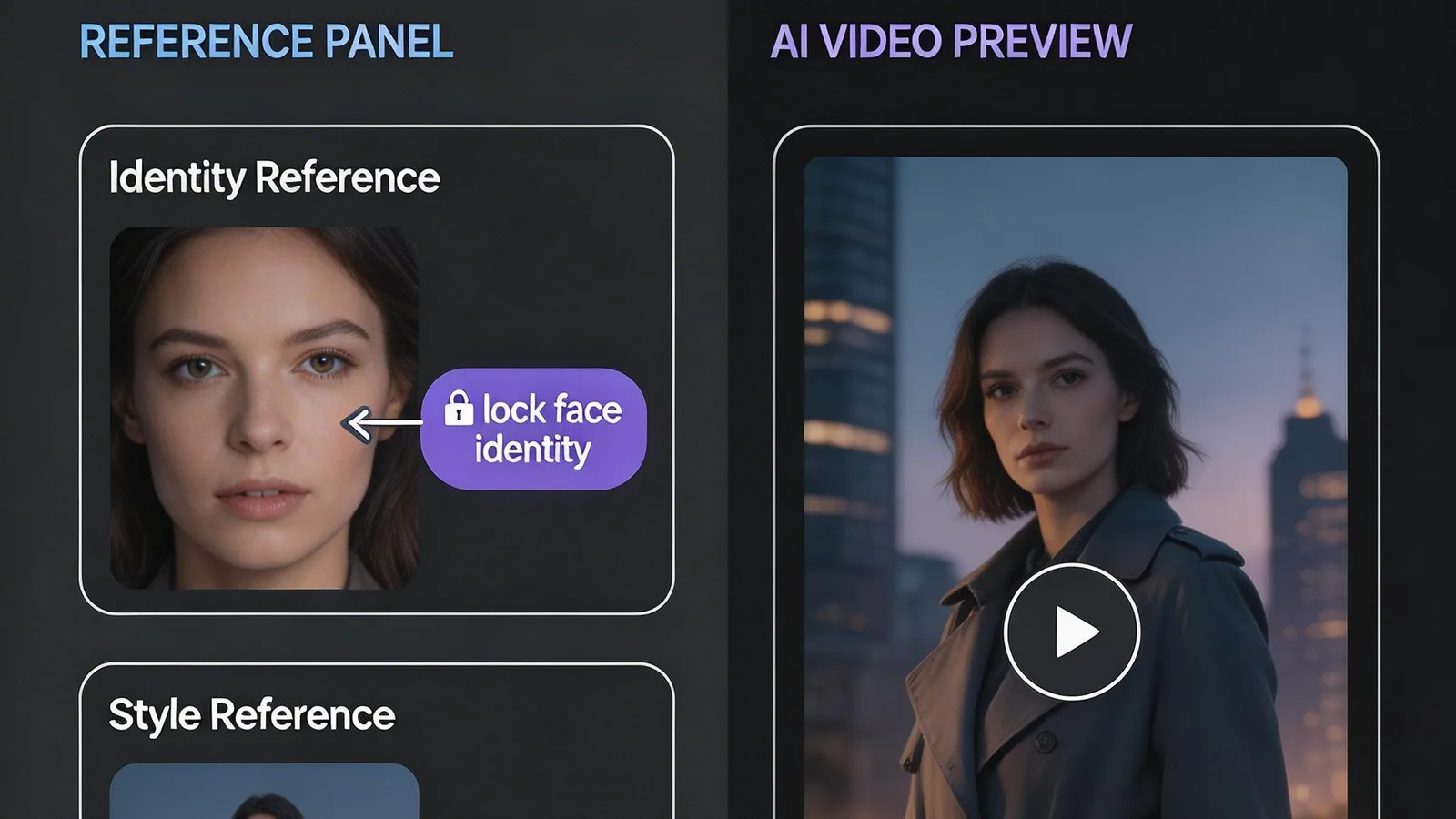
How to use image references correctly
One of the biggest workflow upgrades comes from using image references intentionally rather than emotionally.
Use a reference image when you need to preserve:
- face identity
- wardrobe details
- object design
- composition inspiration
- color palette
But do not expect one image to do everything.
A useful mindset is:
- text controls action
- image controls identity or style
- camera words control perspective
- negative prompts control repeated failure cases
That separation keeps the workflow understandable.
How to use multimodal input without overcomplicating it
Multimodal does not mean "use every possible input every time." It means use the right input for the right uncertainty.
Examples:
- If the face keeps changing, use an image reference.
- If the rhythm matters, test audio guidance.
- If the camera is wrong, rewrite the camera instruction instead of adding more style words.
- If the product shape matters, describe the product clearly and pair it with a product reference image.
The worst workflow is dumping every possible signal into one generation because you are nervous. The best workflow is reducing ambiguity one variable at a time.
A practical six-step SkyReels prompt workflow
Step 1: define the shot objective
Write the goal in one sentence.
Step 2: draft the five-layer prompt
Subject, action, environment, camera, constraints.
Step 3: decide whether a reference is needed
Only add it if it protects something essential.
Step 4: run the first generation
Accept that V1 is diagnostic, not final.
Step 5: label the failure
Was it identity, motion, camera, environment, or continuity?
Step 6: revise only one major variable
Do not rewrite the entire prompt unless the whole structure is broken.
This process is slower than random guessing for the first five minutes, but far faster over twenty generations.
Three high-value use cases
1. Character consistency shots
Prompt goal:
keep face, outfit, and mood stable while changing minor motion or framing
What helps:
- face reference
- clear wardrobe language
- medium or close-up framing
- reduced scene complexity
2. Product ad shots
Prompt goal:
keep object geometry clean while achieving premium lighting and camera motion
What helps:
- specific object description
- minimal background clutter
- commercial camera language
- stable material cues
3. Sports or action shots
Prompt goal:
make the motion readable and physically plausible
What helps:
- one strong motion beat
- clear camera angle
- simple environment
- avoiding too many simultaneous actions
What not to do
Avoid these habits:
- stacking contradictory camera terms
- using five mood adjectives instead of one useful scene description
- changing prompt, reference, and negative prompt all at once
- expecting a comparison page or homepage to serve as a tutorial page
- writing for keyword stuffing instead of clear operator logic
This last point matters a lot. Tutorial intent must feel like it came from real use, not from a content farm.
How this blog post fits the rest of the site
This blog post should not try to do the full job of the prompt guide. It supports that page. The guide is the core tutorial destination. This blog post is a supporting article that captures adjacent long-tail intent and routes users deeper.
Use it to pass readers toward:
- SkyReels V4 for model overview
- SkyReels V4 prompt guide for the main tutorial page
- SkyReels V4 review for product evaluation
- SkyReels V4 vs Sora for comparison intent
- pricing for commercial decision-making
That is how internal linking should work. The blog teaches enough to build trust, then routes the reader to the page that best answers the next question.
What this article still needs before it is truly finished
To fully meet the site's content standard, this article should eventually include:
- real screenshot sequences
- annotated prompt revisions
- side-by-side examples of weak vs strong prompts
- image reference examples
- a short section showing when to use V3 versus V4
- output frames with notes about what worked and what failed
Final takeaway
The practical takeaway is simple: don't optimize SkyReels V4 prompting by writing bigger prompts. Optimize it by writing clearer prompts, using multimodal references intentionally, and separating shot objective from style decoration.
If you want the full tutorial flow, go to the prompt guide. If you want to know whether the model is worth your time, read the review. If you are ready to compare alternatives, check SkyReels V4 vs Sora. And if you are close to a buying decision, go straight to pricing.